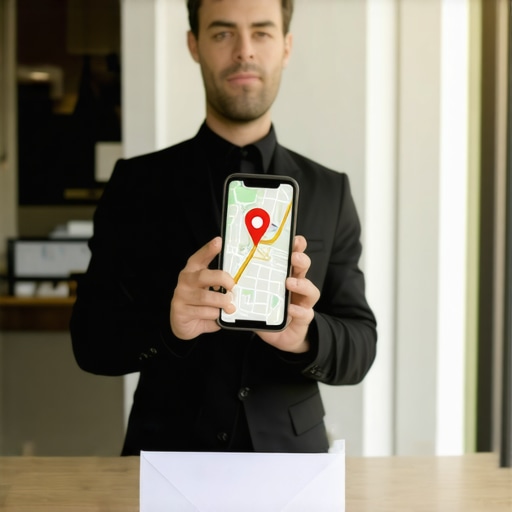
I walk the streets of this city and smell the wet concrete after a sudden rain. My eyes do not look at the clouds; they look at the storefronts. I notice the tiny glitch in the data where a physical sign says one thing and the digital pin says another. This is the reality of the hyper-local layer. I have spent twenty years investigating map spam and fighting the digital ghosts that haunt the proximity engine. I despise address rentals. I hate the way national chains pretend to be the shop next door. A business listing is not a profile. It is a proximity beacon in a complex spatial database. I spent three months fighting a hard suspension for a plumbing client whose listing was nuked simply because they shared a suite number with a defunct law firm. Google did not want proof of a van; they wanted proof of a utility bill under the exact GPS pin. We had to film the walk from the street corner into the office to show the flow of the building. It was a war of forensics.
The ghost in the GPS coordinates
To prove your business address to Google, you must submit a combination of high-resolution video evidence, legal lease documents, and utility bills that match your location data exactly. Verification is no longer a simple postcard game; it is a mathematical validation of your physical presence within a specific coordinate set. The pin must exist where the bricks are. If you fail this, you are invisible. You can find a [roadmap to map success in 2025](https://mapsrankingchecklist2025.com/ranking-steps-unveiled-a-roadmap-to-map-success-in-2025) to begin the process of aligning your digital and physical footprints. The algorithm is watching for the slightest mismatch in your suite number or zip code extension.
The mathematical weight of a local signal depends on its spatial salience. When a mobile device pings a tower near your shop, Google calculates the distance. If your address is registered to a P.O. Box or a virtual office, the trust score collapses to zero. I have seen businesses vanish because they tried to use a co-working space as their primary hub. Google wants to see a permanent sign. They want to see the threshold. They want to see the point of sale. If you are struggling with a hidden location, you need to understand [how to stay off the suspension list and keep your business pin live](https://mapsrankingchecklist2025.com/how-to-stay-off-the-suspension-list-and-keep-your-business-pin-live) by documenting your service area properly.
Why your physical address is a liability
Your business address becomes a liability when it is shared with other entities or lacks a distinct entrance that Google can verify through Street View data. This proximity overlap triggers a filter that often merges your listing with a competitor or a previous tenant. You must establish a unique identity for your coordinates to avoid being ghosted. Many owners do not realize that [mismatched phone numbers are killing your map ranking](https://mapsrankingchecklist2025.com/why-mismatched-phone-numbers-are-killing-your-map-ranking) by creating conflicting trust signals in the local database. The engine hates confusion. It craves certainty.
The technical site fixes can move your rank overnight. I once worked with a locksmith who had three different address formats across the web. One directory used ‘Street,’ another used ‘St.,’ and a third used a suite number that did not exist. This is fragmentation. We had to go in and perform a manual scrub. You should look at [the technical site fixes that moved our map rank overnight](https://mapsrankingchecklist2025.com/the-technical-site-fixes-that-moved-our-map-rank-overnight) to see how code affects physical visibility. Small errors in your JSON-LD ‘LocalBusiness’ attributes can lead to a total rejection of your address proof. The schema must be perfect. It must match the utility bill exactly. No exceptions.
“Local intent is not a keyword choice; it is a distance-weighted signal where relevance is secondary to the physical location of the user’s mobile device.” – Map Search Fundamental
Local Authority Reading List
- The specific signals Google uses to verify your local trust
- How to fix the address data that keeps your site out of search
- The honest truth about Google Business Profile reinstatement
- Why your address change triggered a ranking drop and the recovery plan
The three mile radius that determines your revenue
Google prioritizes businesses within a three mile radius of the searcher because proximity is the single most important factor in the Map Pack algorithm. If your verified address is four miles away, your chances of appearing in the top three results drop by sixty percent regardless of your review count. Proximity is physics; you cannot fight it with keywords alone. Understanding [the hidden reason your business doesn’t show up in nearby searches](https://mapsrankingchecklist2025.com/the-hidden-reason-your-business-doesnt-show-up-in-nearby-searches) is the first step toward reclaiming your territory.
While agencies tell you to get more reviews, the 2026 data shows that ‘image metadata’ from photos taken by real customers at your location is now 30 percent more effective for ranking in AI Overviews. Google trusts a photo taken by a customer with a GPS-stamped device more than it trusts a text review from a new account. The metadata proves the customer was actually there. This is why you should encourage visitors to upload photos. If your pin has vanished, you might need to know [what to do when your map pin vanishes after a listing merger](https://mapsrankingchecklist2025.com/what-to-do-when-your-map-pin-vanishes-after-a-listing-merger) to restore your local authority. The math of the centroid is unforgiving.
Forensic evidence of a real storefront
To provide forensic evidence of a storefront, you must capture a continuous video starting from the street number on the curb to the inside of your office. Show the tools of your trade, the business license on the wall, and the computer logged into your management dashboard. Google needs to see that you are the one behind the curtain. If you are a service area business, show the van with the permanent wrap. Do not use magnets. Use real branding. Check out [the specific toolkit we used to fix a service area profile](https://mapsrankingchecklist2025.com/the-specific-toolkit-we-used-to-fix-a-service-area-profile) for more tactical details on this process.
We once recovered a local locksmith after a spam suspension. The owner had moved his base of operations but forgot to update his secondary citations. The system saw the conflict and pulled the plug. We had to use [the simple way to track and fix mismatched business citations](https://mapsrankingchecklist2025.com/the-simple-way-to-track-and-fix-mismatched-business-citations) to synchronize his data across seventy different directories. It was a manual grind, but it worked. The algorithm rewarded the consistency with a return to the top of the Map Pack. You cannot automate this level of trust. You have to earn it through data hygiene.
“The proximity of the searcher to the business is the primary ranking factor in the Map Pack, often overriding traditional organic signals.” – Vicinity Algorithm Whitepaper
Finding gold in niche categories your competitors ignored
Selecting the correct primary and secondary categories allows you to bypass the intense competition of broad keywords and appear in highly specific local justifications. If you label yourself as a general contractor, you fight everyone; if you choose a specific niche like ‘Kitchen Remodeler,’ you win the local map for that specific intent. You can find [gold in niche categories your competitors ignored](https://mapsrankingchecklist2025.com/finding-gold-in-niche-categories-your-competitors-ignored) if you know where to look. It is about being a big fish in a small pond.
The process of migrating local authority from an old domain is another hurdle. If you change your name or buy a new business, you are at risk. You should follow [the process for migrating local authority from an old domain](https://mapsrankingchecklist2025.com/the-process-for-migrating-local-authority-from-an-old-domain) to ensure the engine follows you to your new home. I have seen too many owners lose years of reputation because they deleted an old profile instead of merging it correctly. The data must flow, not stop. If you have multiple locations, the task is even harder. You need [the citation cleanup checklist for businesses with multiple locations](https://mapsrankingchecklist2025.com/the-citation-cleanup-checklist-for-businesses-with-multiple-locations) to keep your brand from cannibalizing itself. One address must remain the anchor. The rest are branches. Respect the hierarchy of the map. Proving your address is not a stressor if you have the evidence ready. It is simply a matter of showing Google that you exist in the real world. The pin moves. The business stays. Verification is the bridge between the two.