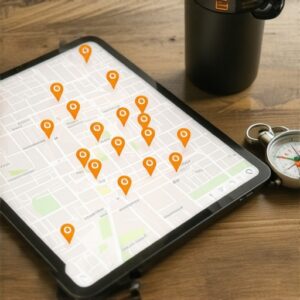
The physics of the map pack and why distance destroys rankings
I spent three months fighting a hard suspension for a plumbing client whose listing was nuked simply because they shared a suite number with a defunct law firm. Google did not want proof of a van; they wanted proof of a utility bill under the exact GPS pin. This logistical nightmare proved that the algorithm treats physical coordinates as the ultimate truth. As a logistics manager, I see the map pack as a dispatch system. If your coordinates are muddled, the dispatch fails. Proximity is the strongest signal in the local algorithm, but it is often a silent killer for businesses that need to reach beyond a three-mile radius. When a user searches for a service, Google calculates the distance between the mobile device and the business centroid. If you are a service area business, you are already at a disadvantage because you lack a public-facing storefront to anchor that proximity. To fight back, you need to understand the microscopic math of GPS salience and how behavioral signals can override the distance penalty.
The three mile radius that determines your revenue
Proximity in Google Maps functions as a spatial weight where the distance between a user and a business location often overrides keyword relevance. To expand a service area reach, businesses must utilize high-authority local backlinks, maintain consistent NAP data across all directories, and optimize for location-specific behavioral signals. The algorithm operates on a distance-weighted decay. This means the further a user is from your verified address, the lower your authority becomes. Many agencies suggest getting more reviews, but that is a surface-level fix. You must actually fix the address data that keeps your site out of search results to see real expansion. I have seen businesses lose 40 percent of their call volume because a competitor moved their pin two blocks closer to the city center. This is not about SEO in the traditional sense; it is about the physics of the map. You need to verify that your service area polygons do not overlap in a way that triggers a filter. If you have multiple listings, you must learn how to separate two local profiles that Google incorrectly merged to prevent authority dilution.
“Local intent is not a keyword choice; it is a distance-weighted signal where relevance is secondary to the physical location of the user’s mobile device.” – Map Search Fundamental
The logistics of the map pack require a clean data footprint. When I audit a profile, I look for the forensic trace of old addresses. Most businesses have a ghost in the machine. This is legacy data from five or ten years ago that still exists on obscure directories. Google sees this and doubts the validity of your current location. If Google doubts you, it shrinks your visibility radius to a tiny circle around your building. You can use a gmb ranking toolkit vs other local seo tools to find these discrepancies. For those struggling with a sudden drop, it is vital to debug a map rank drop without calling google support because their automated systems often provide generic advice that does not address the spatial math. You need to focus on why mismatched phone numbers are killing your map rank and fix them at the source. This is the only way to prove to the algorithm that your business is a reliable beacon in the local database.
The local authority reading list for 2025
- SEO Updates 2025 for Map Marketers
- Unlocking Visibility in Competitive Markets
- A Roadmap to Map Success
- Key Actions for Top Rankings
- Boost Your SEO Strategy Today
Why your physical address is a liability
A physical address becomes a liability when it is tied to inconsistent citations or shared with other entities that have a poor trust score. To mitigate this risk, businesses must conduct a manual citation audit, remove duplicate listings, and ensure that their Google Business Profile address perfectly matches their official government documents and utility bills. In the world of logistics, a mislabeled package never reaches its destination. On Google Maps, a mislabeled address never reaches the customer. I often see service area businesses try to hide their address to avoid the proximity trap, but this often backfires. Google needs a anchor point to trust you. If you are struggling with a suspension, you should read about how we recovered a local locksmith after a spam suspension to see the level of detail required for reinstatement. You must provide a clear paper trail. This includes a manual fix for incorrect business info across the web. Automated tools are often too blunt for this work. They miss the secondary directories that feed the main aggregators. When legacy business data haunts your current rankings, it acts like a drag on your service vehicle. You can’t go fast if the brakes are on. Cleaning up this data is like flushing the lines in a hydraulic system. It allows the authority to flow freely through your profile. Use a specific toolkit to fix a service area profile that focuses on these granular details.
The ghost in the GPS coordinates
GPS coordinate salience is the degree of confidence Google has in your actual physical location based on the aggregation of digital signals. Improving this salience involves uploading geo-tagged images taken by customers, encouraging check-ins, and ensuring your location schema on your website is technically flawless and matches your profile data. Every photo a customer takes at your business contains metadata. This metadata includes the exact latitude and longitude. When Google sees hundreds of photos with the same coordinates, its confidence in your location increases. This allows it to expand your reach because it knows you are a real, physical entity. If you are moving, you must follow the process for migrating local authority from an old domain carefully. A single mistake during a move can ghost your map pin. Many businesses suffer when they don’t understand why their map pin vanished after moving offices. The transition must be seamless. You should also look into why your address change triggered a ranking drop and implement a recovery plan immediately. This involves updating your local business schema and ensuring that broken schema isn’t the reason you aren’t showing up locally. The technical site health is the engine of your local visibility. If the engine is stalling, the map pin won’t move. You need to address the hidden cost of ignoring technical site health for local seo before you spend money on links.
“Relevance is the new proximity. If a business can prove extreme local relevance through behavioral signals, the algorithm will bend the distance rules to show that result to the user.” – Spatial Search Analysis v22
Finding gold in niche categories
Niche category selection involves identifying secondary GMB categories that have lower competition but high intent for your specific service. Utilizing a gmb keyword and category research toolkit allows a business to appear in more specialized searches, which can bypass the general proximity filters of more broad categories. Most plumbers just select plumber. But a logistics expert knows that you need to be where the specific demand is. Maybe you specialize in water heaters or drain cleaning. These secondary categories have different proximity weights. You can find these by finding gold in niche categories your competitors ignored. This is part of a larger local seo checklist and toolkit for gmb. If you have been hit by a penalty for keyword stuffing, you need to know how we fixed the keyword stuffing penalty and finally regained our rank. Over-optimization is a major red flag for the spam team. They look for unnatural patterns in business names. If you are struggling to build trust, consider seo services to rebuild trust after spammy lead gen listings. You need to prove that you are a legitimate local merchant, not a lead generation ghost. Use the tool we used to find and fix hidden profile errors to ensure your data is clean. This includes fixing broken redirects that are breaking your local search authority. Every technical error is a signal of unreliability. In a dispatch system, unreliability is the end of the road. You must maintain your digital assets with the same rigor you maintain a fleet of service trucks.
[image placeholder]
The three levels of local data verification
The three levels of local data verification include primary data providers like Google Business Profile, secondary aggregators like Acxiom and Foursquare, and tertiary local signals like community backlinks and local news mentions. Synchronizing these three levels creates a trust shield that protects your ranking from algorithm shifts and competitor spam. I have audited hundreds of profiles and the most common failure is at the secondary level. Many businesses ignore why mismatched phone numbers are killing your map ranking on sites they have never heard of. But Google hears of them. Google uses these sites to verify the data on your primary profile. If the data does not match, the trust score drops. You should look into citation cleanup services for local businesses that actually do the manual work. Avoid services that use automated APIs because they often fail to update the deepest layers of the web. This is why your citation cleanup failed and the specific tools to fix it. You need a surgical approach. This includes fixing business name errors that trigger profile suspensions. If your name is different on Yelp than it is on Google, you are asking for trouble. It is also important to spot invisible technical errors on your service pages that might be confusing the crawler. If the crawler can’t verify your location on your own website, it won’t trust your map pin. You need a real map ranking toolkit for a growing business to manage all these moving parts. Finally, focus on how to manage local reviews to boost your ranking authority. Reviews are not just for social proof; they are geographical signals. When a customer says I am so glad they came to my house in Springfield, Google associates your business with the Springfield coordinates. This is how you expand your reach beyond your physical address and stop proximity from killing your business.